
What Is Compound Growth?
Compound growth is simple: your money earns money, and then the money it earned earns more money. And so on, year after year.
Think of a snowball rolling down a hill. It starts small, but each turn picks up more snow, so it gets bigger and faster. Your money works the same way.
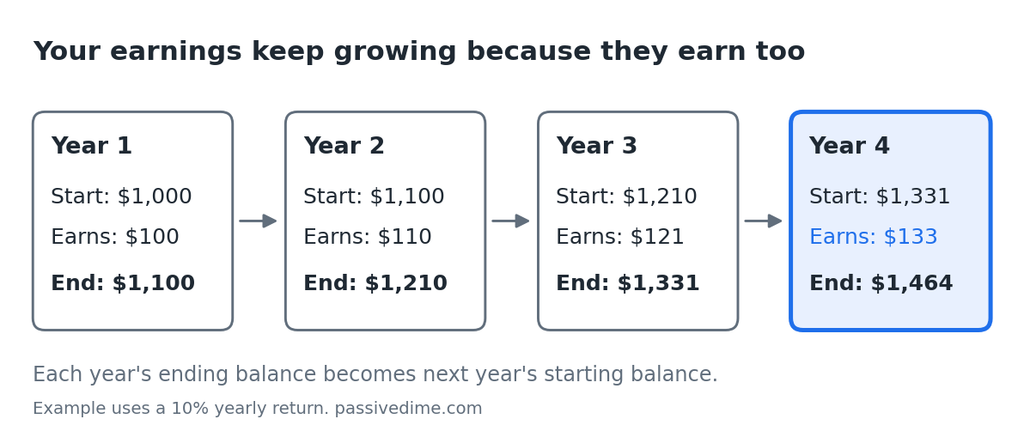
Notice the pattern: you did nothing extra, yet the amount earned each year gets bigger. That is
compound growth.
Simple Interest vs. Compound Interest
With simple interest, you only earn on your starting amount. With compound interest, you earn
on your starting amount and on everything it has already earned.
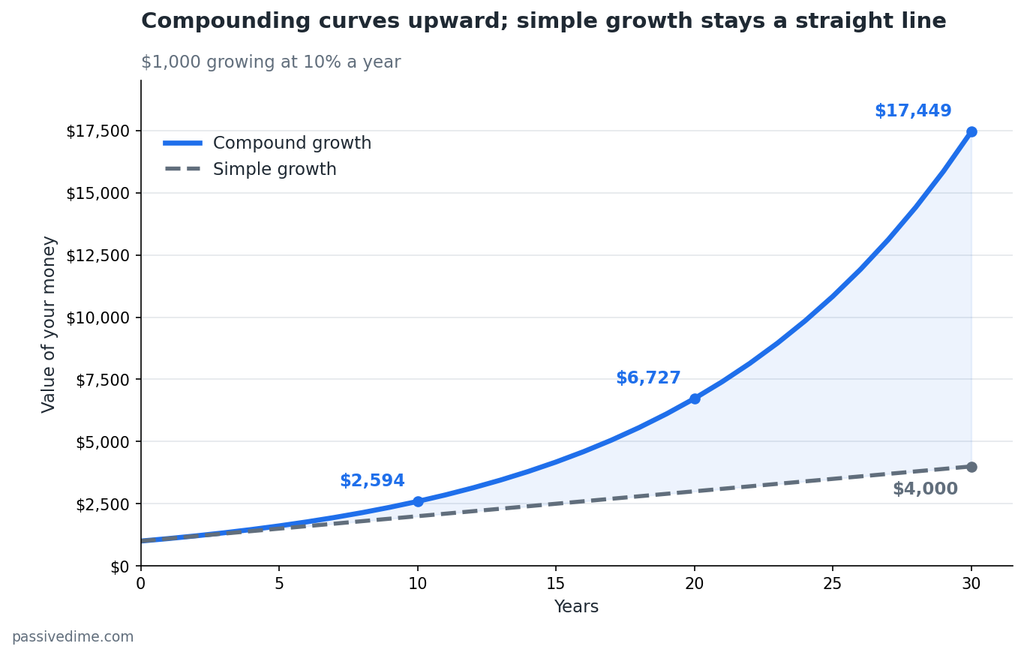
At first the two look almost the same. After 30 years, compounding is worth more than four times as much. The line doesn’t climb steadily, it curves upward.
Lower return, same lesson: $1,000 at 7% for 30 years becomes about $3,100 with simple growth, but about $7,612 with compounding.
The Formula (Don’t Worry, It’s Easy)
Future value = Starting amount x (1 + rate) ^years.
Example: $1,000 at 7% for 30 years
$1,000 x (1.07)30 = about $7,612
You don’t need to calculate this by hand. Any free online compound interest calculator will do it. What matters is understanding the idea.
Why Time Matters More Than Anything
The biggest ingredient in compound growth is time. Starting early beats starting big.
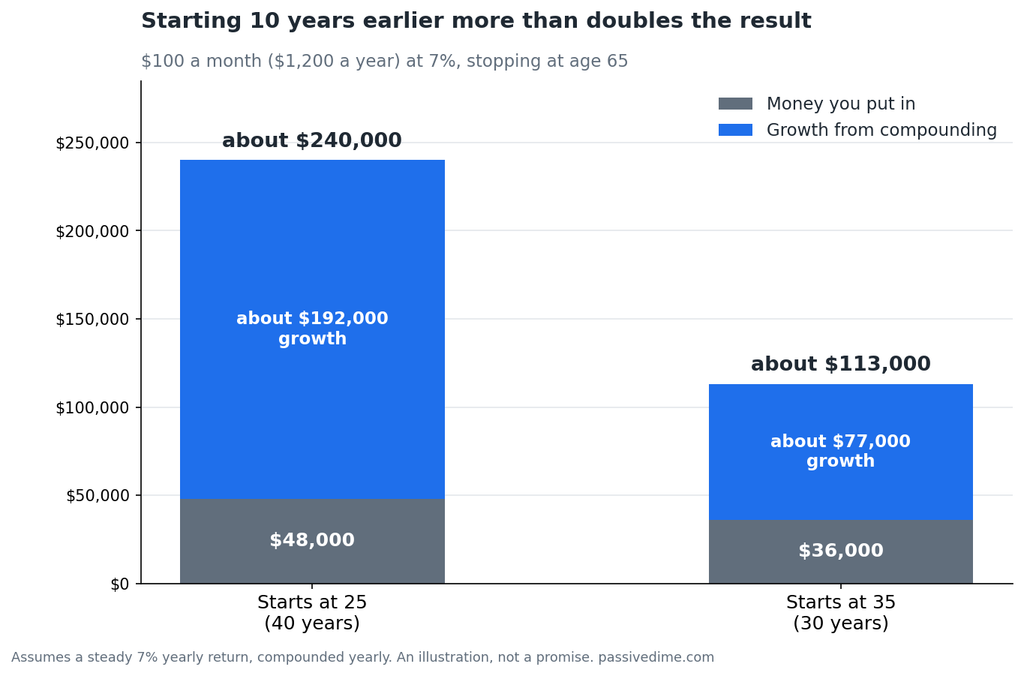
The person who started 10 years earlier put in only $12,000 more but ended up with more than double. Those extra early years had the longest time to snowball.
These figures assume a steady 7% yearly return, compounded yearly. Real returns go up and down. This is an illustration, not a promise.
The Rule of 72: A Quick Mental Shortcut
Want to know how long it takes your money to double? Divide 72 by your yearly return.
72 / 7% = about 10 years to double
72 / 10% = about 7 years to double
72 / 3% = about 24 years to double
At 7%, your money doubles about every 10 years. Then the doubled amount doubles again.
A Real Story: The Sheep Example
In my last post, How to Start a Small Business on a Low Income, I told the true story of a friend who worked on a low salary and was always broke before the month ended.
He changed his mindset first, saved 20% of his income for four months, and bought two sheep with 280,000 SDG (Sudanese pounds). Then he did the one thing that matters: he never spent the profit. He put it back to work every round.
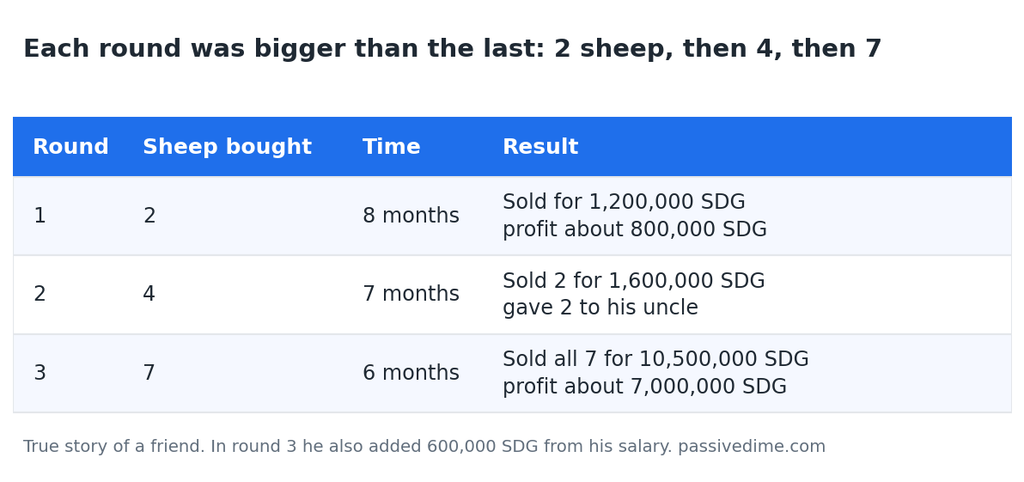
Each round was bigger than the last: 2 sheep, then 4, then 7. His profit earned more profit. That is compound growth in real life, and it took him about two years. (In round 3 he also added 600,000 SDG from his salary.)
Want the whole story? See every step he took, the three books that changed his mindset, and how he protected himself from risk. Read How to Start a Small Business on a Low Income
How Compound Growth Connects to Investing
Compound growth is the engine. Investing is the vehicle that lets you use it. A regular bank account can compound, but usually at a low rate. Investing, for example in a diversified index fund, gives your money the chance to grow faster.
When you reinvest your gains and dividends instead of spending them, those gains start earning too. That is compounding in action.
You invest money
|
It earns returns or dividends
|
You reinvest them
|
A bigger amount now earns returns
|
(repeat for years)
New to investing? Start here: how to start Investing as a Beginners Complete Guide (2026).
The Dark Side: Compounding Works Against You Too
Compounding doesn’t care which direction it goes. Debt compounds too. A $1,000 credit card balance at 20% interest, left unpaid, grows to about $1,728 in 3 years.
The same snowball that builds wealth can bury you in debt. Paying off high-interest debt first is a guaranteed way to stop the snowball working against you.
How to Use Compound Growth Starting Today
1. Start now, even small. $20 a month today beats $200 a month ten years from now.
2. Be consistent. Add money every month, automatically if you can.
3. Reinvest your earnings. Don’t pull out the growth.
4. Keep fees low. Fees take a bite out of what compounds.
5. Be patient. The biggest growth happens in the later years.
6. Pay off high-interest debt. Stop compounding from working against you.
Key Takeaways
• Compound growth means your money earns money, and that money earns more.
• Time is the most powerful ingredient. Start early.
• The Rule of 72 shows how fast your money doubles.
• Compounding also works on debt, so avoid high-interest balances.
• Investing is how most people put compound growth to work.
Ready for the next step? Read how to start Investing for Beginners 2026.
Disclaimer: This post is for education only and is not financial advice. Investment returns are not guaranteed, and all figures above are illustrations.